Bidirectional Charging in 2026: Where We Stand, What It Means, and What We’re Still Waiting For
Almost every day, I get questions about bidirectional charging. Some ask whether V2G is ready for the market. Others wonder if they should hold off on buying charging equipment. Some want to know whether a car they’re considering supports “V2G”. And some have just read that bidirectional charging will revolutionise the energy system — and want to know whether it’s hype or substance.
That’s why I’ve sat down and written this post. Not to give simple answers — there aren’t many of those here — but to give you an honest picture of where we actually are.
The Technology Is Called Bidirectional Charging
La meg begynne med et begrepsavklaringspunkt som jeg synes er viktig: V2G er ikke en teknologi. Det er et bruksområde. Det samme gjelder V2H, V2B og alle de andre forkortelsene i V2X-familien.
Teknologien heter toveislading eller bidireksjonal lading. Bidirectional charging på engelsk. Det betyLet me start with a point of terminology that I think matters: V2G is not a technology. It’s a use case. The same applies to V2H, V2B, and all the other abbreviations in the V2X family.
The technology is called bidirectional charging. It means energy can flow in both directions between the vehicle and the outside world. The battery in your car is no longer just a container you fill up — it’s a flexible energy store that can deliver energy back when the conditions are right.
V2G, V2H, and V2B describe what that energy is used for:
- V2G (Vehicle-to-Grid) — the car delivers power to the distribution network, managed by an aggregator or grid operator on the supply side of the meter
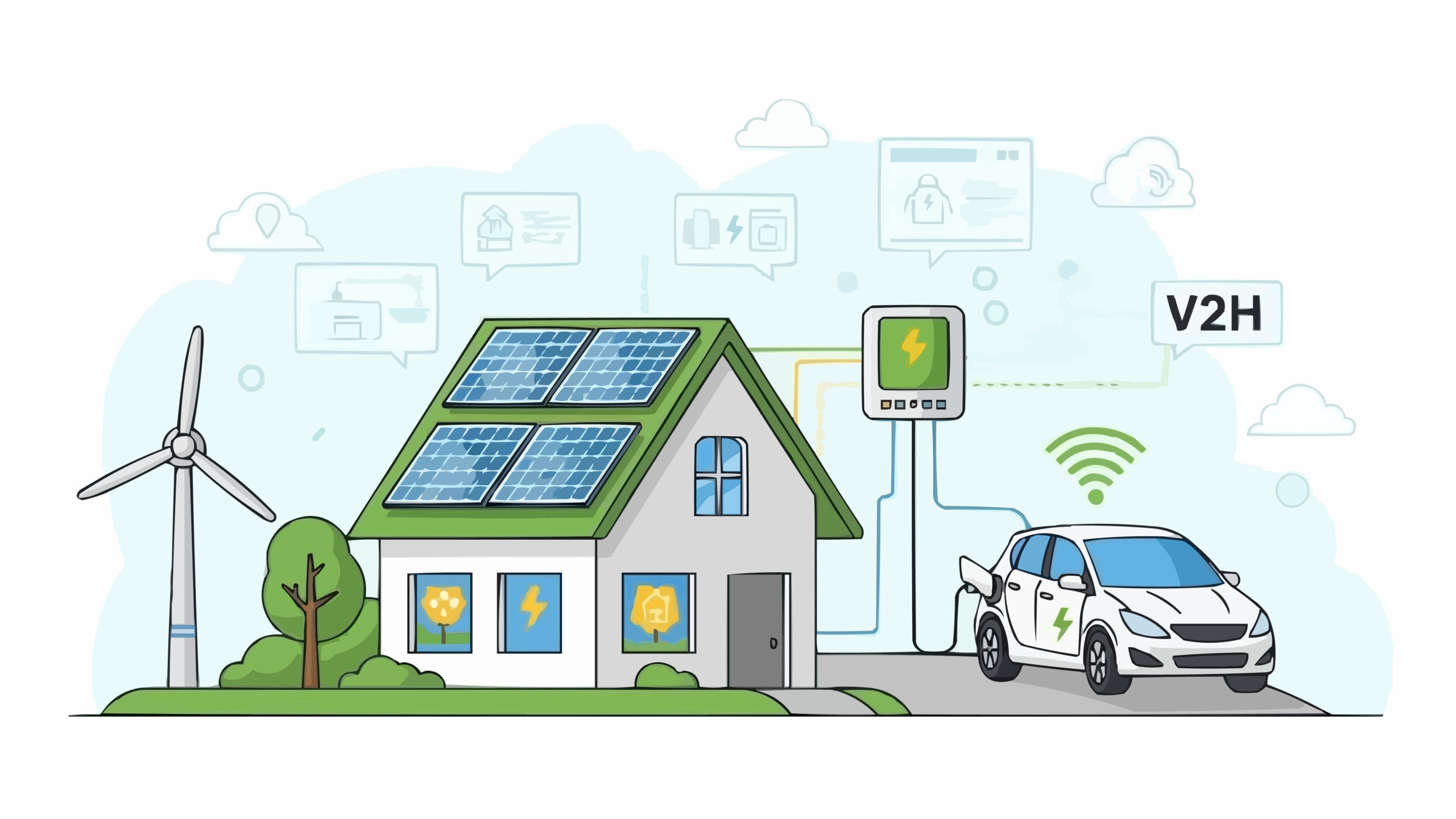
- V2H (Vehicle-to-Home) — the car powers your home, either to cut electricity costs or as a backup during outages. Control is handled via a Home Energy Management System (HEMS) on the consumption side of the meter.
- V2B (Vehicle-to-Building) — the same principle as V2H, but scaled up for commercial buildings
The boundaries between these are not rigid. A single installation can do both — supply the house in the evening and provide grid flexibility in the middle of the night. Hybrid solutions are often the most sensible, and they will likely become the norm over time.
So if you ask whether a car “supports V2G”, it’s a bit like asking whether a car “supports driving to the cabin”. The answer doesn’t depend on a single feature — it depends on whether the underlying technology is in place, and whether the rest of the system around it is set up correctly.
Stay up to date
Don’t miss updates and new blog posts — sign up for my newsletter!
Two Technologies, Several Trade-offs
Bidirectional charging comes in two variants: AC and DC. The difference is about where the power electronics are located.
AC bidirectional charging means the inverter is inside the vehicle. The charger on the outside is relatively simple — it sends alternating current in and out, and the car handles the conversion to and from the DC battery. Familiar connectors, lower cost for the charging station, typically 7–22 kW. It is called AC bidirectional charging because alternating current (AC) passes through the car’s charging connector.
DC bidirectional charging means the inverter is in the charging station, outside the vehicle. Direct current is sent straight to the battery. More sophisticated equipment, higher cost — but more powerful grid integration and better suited to complex installations. It is called DC bidirectional charging because direct current (DC) passes through the car’s charging connector.
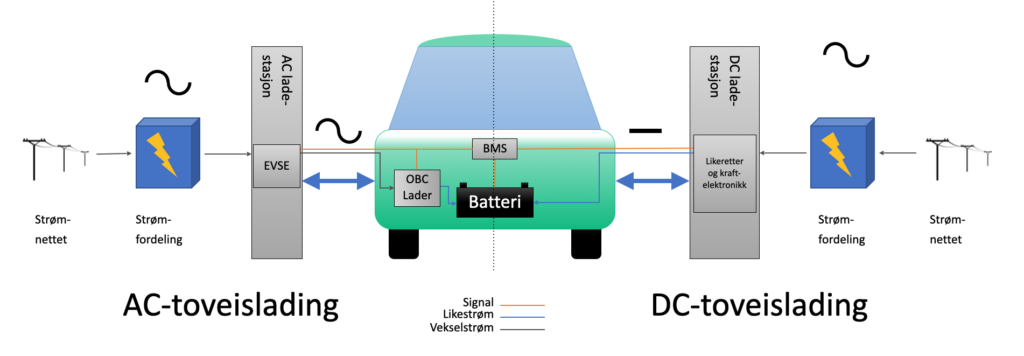
Here I want to pause on a misconception I encounter regularly: DC charging is not the same as fast charging.
The association is understandable. The fast chargers along motorways are DC, and they charge in minutes. But DC says nothing about power level — it describes where the inverter is located. A DC charge point at home can just as easily deliver 7–11 kW overnight. Power level is a separate choice. And in many home and workplace bidirectional charging scenarios, low power over a long period is exactly what makes sense — the car is parked for eight hours anyway.
Norway’s Distinctive IT Networks
Large parts of Norway use IT-earthed networks (isolated earth systems) rather than TN networks. For AC bidirectional charging, this is challenging. The requirements for insulation and protection are different, and achieving stable three-phase AC bidirectional charging on an IT network presents real technical and safety challenges — challenges that have not been resolved in either standards or products today. It is also unlikely that future international standards will be adapted specifically for a network topology as limited in global reach as our IT network.
For these installations, a DC solution may actually be the right choice — not despite the higher equipment cost, but because it solves the problem correctly. All the power electronics sit in a single unit that can be certified and dimensioned for Norwegian grid conditions, rather than placing responsibility on the car’s built-in inverter, which was not designed for IT networks.
This is a point I believe needs to be central to Norwegian specifications and procurement going forward. Even though DC equipment carries a higher upfront cost, Norwegian-specific adaptations based on AC technology are likely to be both technically demanding and expensive, and DC will, in total, prove to be the more robust and cost-effective solution for our grid.
Grid-Following or Grid-Forming — A Distinction That Matters Enormously for Backup Power
Here is something many people overlook when they imagine using their car as emergency power during an outage.
A standard bidirectional charging solution is what we call grid-following. This means the inverter synchronises with the voltage and frequency of the grid — it follows the grid. That works perfectly well when the grid is up. But when the grid goes down, the inverter has nothing to follow. It shuts off. This is, in fact, a deliberate safety feature: no one should be sending power into a grid where electricians may be working.
For your car to power your home during a grid outage, you need a grid-forming solution. In this case, the inverter creates its own small grid — it generates stable voltage and frequency independently, isolates the house from the distribution network via a switch, and supplies the property as a self-contained unit. This is technically far more demanding, and it requires both the right equipment and a carefully designed installation.
The distinction matters because most products on the market today are grid-following. They support bidirectional charging — but not backup power during outages.
And here is a point from standardisation work that I think is worth noting:
In the development of the next edition of IEC 61851-1 — the standard for AC charging stations — within IEC TC69, it now appears that grid-forming will not be included in this revision. The work is simply too complex to resolve in this cycle. That means a standardised solution for AC-based backup power via bidirectional charging is still many years away. Products can of course be developed without a completed standard, but without standardisation it is harder to ensure safety, interoperability, and certification across manufacturers.
For DC charging, the situation is different. The DC standard IEC 61851-23 has already taken steps in the right direction and includes a framework for bidirectional power transfer. The DC topology is inherently better suited to grid-forming, because all power electronics sit in a dedicated station that can be dimensioned and certified for grid-forming operation and tailored to the specific installation it becomes part of.
Combining this with the IT network challenge I described above, the conclusion is fairly clear: if you want bidirectional charging with backup power capability in Norway, the evidence points towards DC.
Interoperability — The Invisible Barrier
From 1 January 2027, ISO 15118-20 will be mandatory for all newly installed AC charging stations in the EU — both public and private. This means the communication foundation for bidirectional charging will gradually become standard in the residential market as well. Norway will follow through the EEA Agreement.
But having a standard is one thing. Having different cars and charging stations actually communicate reliably in practice is another.
We are not there yet. Each car brand and each charging station manufacturer has largely developed its own solutions, built on their own interpretation of ISO 15118-20. Combine a car from one manufacturer with a charging station from another, and there is no guarantee that bidirectional charging will work. The problem is not a lack of standards — it’s that the implementations diverge. This is not “plug and play”; it is “bugs and gaps”. The specific incompatibilities are not yet systematically mapped.
This is precisely what IEA Task 53 – «Interoperability of Bidirectional Charging» (INBID) – is working on. The initiative, supported by 15 countries and anchored in the IEA’s Technology Collaboration Programme, tests combinations of vehicles and charging stations in recognised laboratories, identifies interoperability issues, and works to resolve them. I am not personally part of this work, but I follow it closely.
An important step came in September 2025, when Volkswagen became the first car manufacturer to join Task 53 as a formal partner. That signals that the industry is beginning to take this seriously — not just as a marketing message, but as a technical commitment. Virta, CharIN, and Linux Foundation Energy are among the other organisations that have joined, as has the Norwegian charging station manufacturer Zaptec.
The current situation is that bidirectional charging solutions are being offered by certain vehicle manufacturers, but these almost always require you to buy the right car model, the right charging station, and tie yourself to a specific energy supplier. If you subsequently want to change your car or energy supplier, the solution will no longer work. That is clearly not a sustainable approach.
Task 53’s goal is interoperable bidirectional charging across manufacturers and suppliers by 2027. That is ambitious. It is achievable. But we are not there yet.
So — Is Bidirectional Charging Ready for You?
t depends on what you want to achieve.
For commercial buildings and fleets, the picture is more promising. Parking times are predictable, capacity is meaningful, and energy management can be professionally optimised. The first commercial solutions are already in operation here, though they are bespoke implementations that ensure the vehicle and charging infrastructure communicate reliably.
For private homeowners, the picture is more nuanced. The selection of cars with bidirectional charging capability remains limited — the major European volume models are not yet widely available with this feature. And the economics for individual users are difficult to predict.
Do you want backup power during an outage? Then you need a grid-forming solution. And right now, it is DC that gives you that option — particularly here in Norway.
My assessment: don’t wait passively, but equally, don’t invest without having thought carefully about what you actually want to use it for. Make sure the charging infrastructure you choose is specified for bidirectional charging — that is sound future-proofing regardless. And if you’re on an IT network and want backup power: take a thorough look at AC versus DC. The answer is not simple or entirely clear-cut, but it is entirely possible to start preparing. One final piece of advice: don’t rush in and find yourself locked into a closed ecosystem.
Bidirectional charging is not a distant future prospect — but we are not at the finish line either. We are in the middle of the most interesting chapter. That’s why I’ll be following up with more posts on this topic going forward.