The battery works even when the car is parked — and that is the warranty problem with bidirectional charging
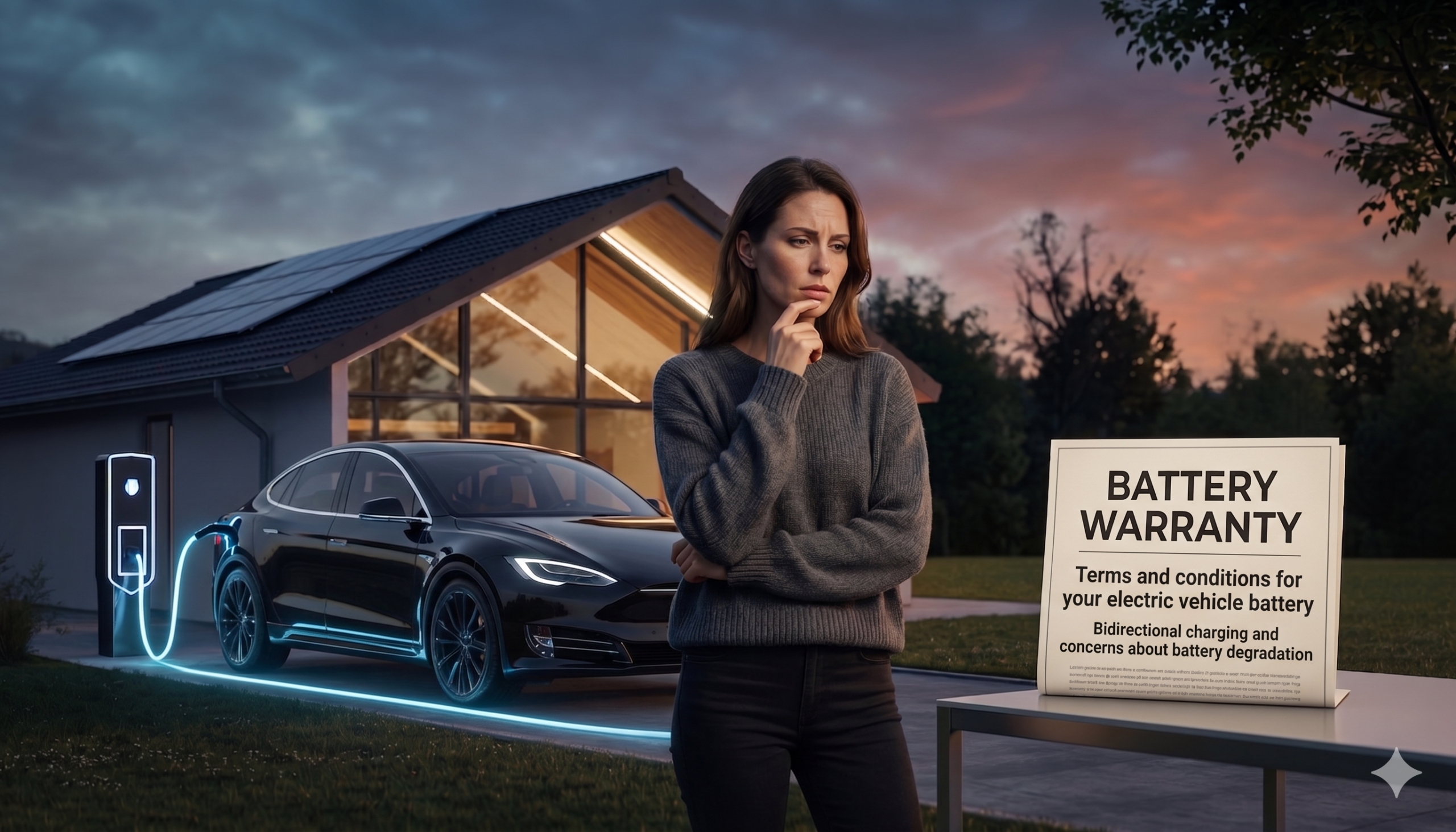
The concern is understandable. You’re considering using your car as a home battery, or feeding power back to the grid — and then you start wondering whether that means losing your battery warranty. The answer is neither yes nor no. It’s a question of precision.
What is a battery warranty, exactly?
Most vehicle manufacturers structure their battery warranties around three elements: time, mileage and a minimum capacity threshold. A typical warranty covers the battery for eight years or 160,000 km, guaranteeing that it retains at least 70 percent of its original capacity during that period.
That’s a reasonable construction — for normal driving. Time and mileage are good proxies for battery use when the car is actually used for driving.
Bidirectional charging changes that equation.
The battery works even when the car is parked
When you deliver power from the car to your home, a building or the grid, the battery is doing work — but the odometer doesn’t move. The car can sit in the garage delivering kilowatt-hours hour after hour without the mileage counter registering a single kilometre.
That creates an asymmetry. The warranty sees a car that has barely been driven. The battery has nonetheless done significant work.
This was one of the first objections raised when bidirectional charging began moving from concept to reality. Five or six years ago, installers, fleet operators and aggregators were all asking the same question: what happens to the warranty?
Virtual kilometres: a solution from the standardisation process
The answer that took shape in the international standardisation work is elegant in its simplicity. If the odometer cannot measure battery use, we need another way to make it visible.
The solution is called virtual kilometres. The concept was developed in UNECE’s working group on electric vehicles, IWG EVE — the group that produced GTR No. 22, the global technical regulation for in-vehicle battery durability in electrified vehicles. When this problem was being discussed in EVE, and I was following the work as the FIA representative, the core of the question was exactly this: how do you make bidirectional charging visible in the battery’s lifetime account — not just in driving kilometres?
The formula is intuitive. Take the total energy the battery has delivered to external purposes through two-way charging, and divide by the vehicle’s certified energy consumption per kilometre. The result is virtual kilometres — a measure of battery work, expressed in a language the automotive industry already understands.
A concrete example: the vehicle delivers 20 kWh to a home through V2H. Certified consumption is 200 Wh/km. That gives 100 virtual kilometres. The car has not driven 100 km. But the battery has delivered an amount of energy that can be regulatorily equated with exactly that.
From concept to regulation
Virtual kilometres are no longer just a concept from standardisation work. They are now a defined data element in EU type-approval legislation.
The Euro 7 regulation introduces requirements for battery durability, SOH monitoring and communication between vehicles and charging infrastructure. It’s worth pausing here on what SOH actually measures — and what it doesn’t.
SOH, or state of health, is commonly used as an umbrella term for a battery’s remaining performance. But in the Euro 7 framework and the GTR 22 work, two more precise indicators are used. SOCE — State Of Certified Energy — measures remaining usable battery energy relative to the certified initial value. SOCR — State Of Certified Range — measures the equivalent for driving range. Together, these give a more concrete and verifiable picture than SOH alone, and they are central parameters when battery health needs to be documented in a potential warranty dispute.
The Euro 7 implementing rules further define specific data parameters including virtual distance and total discharge energy in V2X — the total energy the battery has delivered to external purposes through bidirectional charging over its entire lifetime.
The regulatory shift is from “bidirectional charging as an ambiguous add-on feature” to “bidirectional charging as traceable and measurable battery use.” Vehicles supporting two-way charging will, under this framework, be required to display virtual distance alongside conventional mileage and SOCE.
Euro 7 does not mandate V2G or V2H functionality for all vehicles. But when bidirectional charging is used, that use must be documentable.
What does the situation look like in practice today?
The regulation sets the framework going forward. But what about the vehicles already on the road?
The picture is mixed.
Nissan and Fermata Energy offer the clearest example of warranty and bidirectional charging coexisting. Nissan has approved a specific combination of vehicle, charger and software platform — and confirmed that using this equipment for two-way charging does not affect the LEAF warranty. This is not a blanket V2G approval. It is approval of a controlled, defined use case with known hardware and known operating parameters.
BYD and Amber are running a similar pilot in Australia, where BYD has provided battery warranty coverage for a limited number of customers in a V2G trial. One of the aims is to document that controlled bidirectional charging does not affect battery health beyond normal driving use.
Major manufacturers such as Hyundai and Ford publish clear battery warranties with time and mileage limits — but those warranties do not mention bidirectional charging explicitly. That is not necessarily a no. But it is not a yes either. That grey area is where most vehicles sit today.
Four questions worth resolving
The claim that bidirectional charging automatically voids the warranty is too blunt. So is the claim that it never does.
The right question is whether the two-way charging is explicitly approved, measurable and contractually defined. Before entering into a V2G or V2H agreement, there are four things to clarify:
Does the manufacturer explicitly support bidirectional charging? Not just “the car is technically capable of delivering power,” but written confirmation that this is intended use within the warranty terms.
Which charger and software version is approved? The Nissan/Fermata example shows that approval may be tied to one specific combination — not any charger with the right connector type.
Are there defined limits for bidirectional use? Maximum power, total energy volume, SOC window or virtual kilometres. Limits make the use measurable — and the warranty manageable.
Who has access to the battery data? SOCE, energy throughput and charge cycles are the actual evidence in a warranty dispute. Clarify who can document what, and how.
The warranty needs a new vocabulary
Bidirectional charging does not make the battery warranty irrelevant. It forces it to become more precise.
Time and mileage were sufficient when the car was purely a means of transport. When the battery is also an energy storage resource for homes, buildings or the power system, the old measurement language no longer holds. Virtual kilometres are an attempt to bridge the gap — between the automotive industry’s mileage logic and the energy industry’s kWh world.
The regulation is moving in that direction. The first manufacturer-approved agreements already exist. But for most vehicles currently on the road, the practical answer remains the same: ask explicitly, confirm in writing, and make sure the data is accessible.