The technology is ready. The regulatory framework is not.
Your electric car can, in principle, deliver power back to your home, to your neighbourhood, and — in theory — to the energy market. Not in the future. Now. The communication standards that make it possible are published and in use. The EU has set a binding deadline. Commercial services already exist in the Netherlands, the United Kingdom, and Germany.
And yet: in Norway, commercial two-way charging is barely visible.
This is not a story about missing technology. It is a story about missing frameworks.
What is VGI, exactly?
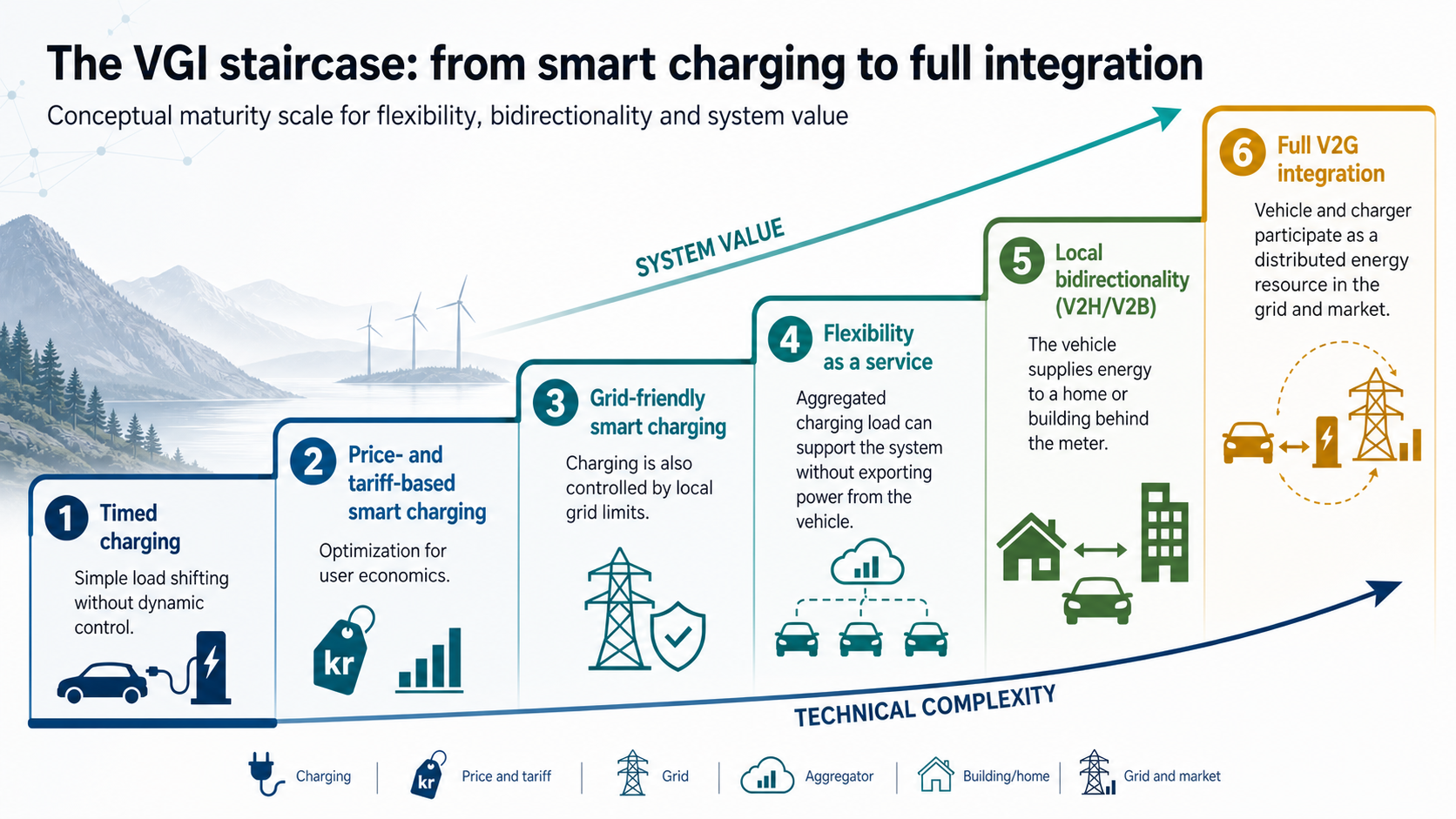
Vehicle-Grid Integration — VGI — is the umbrella term for all the ways electric vehicles can interact with the power grid. It spans from the straightforward — delaying charging until electricity is cheapest — to the considerably more advanced: your car functioning as a distributed energy resource, delivering balancing power to the grid.
It helps to think of VGI as a staircase. At the bottom, you have time-controlled charging with no dynamic management. Above that, price- and tariff-based smart charging, where the charging algorithm responds to spot prices and capacity tariffs. Higher still comes grid-friendly smart charging, which also accounts for local grid constraints. At the bidirectional levels, you find V2H and V2B — where the car delivers energy to a house or building behind the meter — and finally full V2G integration, where both car and charger participate as a distributed energy resource in grid and market operations.
Most Norwegian EV drivers are on step one or two. The system needs us to reach steps five and six.
The standards are in place
For two-way charging to work across vehicles, chargers, and systems from different manufacturers, a common communication language is essential. Two standards are particularly central.
ISO 15118-20, published in April 2022, defines the communication between vehicle and charger. This is the standard that enables Plug & Charge — automatic authentication without an app or card — and that establishes the technical foundation for bidirectional power transfer (BPT), meaning two-way charging where current can flow in both directions through the charging cable. OCPP 2.1 (Open Charge Point Protocol version 2.1), released by the Open Charge Alliance in January 2025, handles communication between the charging station and the systems that operate and manage charging networks — typically referred to as a Charge Point Management System (CPMS). With OCPP 2.1, support for ISO 15118-20 and V2G is built in from the outset.
The standards are no longer the obstacle. They are in place.
There is, however, an important qualification: a published standard is not the same as a system that works in practice. Two technical challenges remain. First, interoperability. Different vehicles and charging stations interpret ISO 15118-20 differently, and pairing a car from one manufacturer with a charger from another offers no guarantee that two-way charging will actually function. Second, AC two-way charging has unresolved challenges in Norway’s IT-earthed grid, and grid-forming capability — the ability to supply a home during a power outage — does not appear to be included in the next revision of IEC 61851-1. I have written more extensively on both of these issues in an earlier post on two-way charging in 2026.
The EU has set the deadline
In June 2025, Regulation EU 2025/656 was published in the Official Journal of the EU. It supplements AFIR — the Alternative Fuels Infrastructure Regulation (EU 2023/1804), the EU’s overarching regulatory framework for charging infrastructure — and sets clear requirements for AC chargers, that is, the standard wall boxes used at home and in the workplace.
From 8 January 2026, all newly installed publicly accessible AC chargers must support ISO 15118-2, the earlier version of the standard.
From 1 January 2027, the requirement tightens: all new and renovated AC chargers — both public and private — must support ISO 15118-20. Any new wall box installed after that date must have the communication capability required to enable two-way charging.
This is not a requirement for two-way charging to actually take place. It is a requirement that the infrastructure must be ready to handle it.
One important caveat: AFIR, along with the supplementary regulation containing the ISO 15118-20 requirement, has not yet been implemented in the EEA or in Norwegian law. Legislation is in progress, however, and the requirements are expected to enter into force in Norway in early 2027 — provided the implementation stays on track.
The technology is ready. The framework is not.
Here lies the paradox: even though the communication standards are in place and the EU is mandating the infrastructure, the conditions that would allow two-way charging to actually be used commercially are far less developed.
For an EV owner to sell power back to the grid — or participate in the balancing market through an aggregator — a number of things beyond the charger itself must be in place. An aggregator is needed to pool capacity from many vehicles and bid it into the market. Clear rules are needed on who the aggregator is, what it is permitted to do, and how settlements are calculated. And a tariff and grid-fee structure is needed that actually rewards flexibility, rather than making it most profitable simply to charge up overnight.
None of these elements are adequately defined today — neither in EU regulation nor in Norwegian implementation.
The aggregator role is a telling example. The aggregator is the intermediary between individual EV owners and the markets that demand flexibility. But the role is not clearly enough defined in European regulation, and that makes it difficult to build commercially viable services on top of it. A recent study published in Energy Conversion and Management found that large-scale V2G adoption across Europe is constrained by, among other factors, undefined grid codes and unclear communication standard requirements between market participants — not merely by the charging technology itself.
The Norwegian market is not without movement. The Norwegian EV Association and Volue are collaborating on a pilot service for grid-friendly charging for Norgesnett customers, rewarding EV owners with approximately NOK 1,200 in annual rebates for charging at grid-favourable times. It is a concrete and positive step. But this is smart charging — one-way, price- and grid-managed — not two-way charging.
At the system level, work is under way on the digital infrastructure that will eventually make full VGI possible. Statnett, with Elhub as partner, is leading the “flexibility register” work package in the Euroflex project, mapping and piloting the functionality for a central register where flexible resources — including electric vehicles — can be registered and connected to various markets. In 2026, Elhub received a separate mandate from Statnett to develop a flexibility register to open Statnett’s reserve markets to small, aggregated resources, drawing directly on the experience gained through the Euroflex project.
That is precisely the kind of digital foundation that system-level VGI actually requires.
What is missing?
Three gaps stand out as the most significant barriers right now.
Vehicle compatibility remains limited. Of the models actually sold in Norway today, relatively few support two-way charging. The older Nissan Leaf with CHAdeMO, the Kia EV9, and certain Volkswagen ID models — though availability has been limited and market-specific — are among the best-known examples. The list is growing, but slowly.
Settlement and metering for bidirectional power flow are not yet in place. Power flowing out of a vehicle and into the grid is technically possible. Settling it correctly, taxing it appropriately, and distributing revenue between the owner, the aggregator, and the grid operator — that remains unsolved.
The market design does not reward flexibility sufficiently. Norway’s grid tariff structure has improved with the introduction of capacity-based pricing, but it is still not configured to give EV owners meaningful income from offering grid services.
So what happens in 2027?
From 1 January 2027, all new chargers in the EU must support ISO 15118-20. That means the infrastructure installed from that point will be communication-ready — even if two-way charging is not necessarily activated from day one.
That is not an end goal in itself. But it is a foundation. And it is the first time a regulatory anchor exists to ensure that VGI-capable infrastructure is actually scaled. It is also reasonable to expect the ISO 15118-20 requirement to apply in the EEA, including Norway, in early 2027.
The central question is no longer whether the technology exists. It is whether the regulatory framework, the market design, and the digital infrastructure will come together quickly enough to realise the actual potential — and whether Norwegian authorities, grid operators, and EV owners will be ready to take the necessary steps when the deadline arrives.