What does V2G mean?
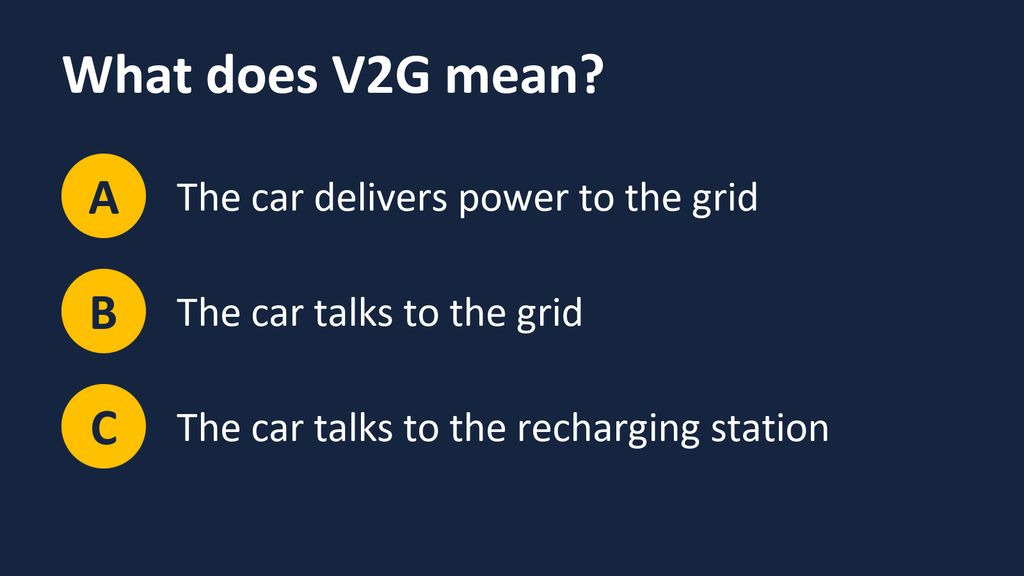
At a conference for Norwegian electrical contractors in November, I asked the audience a simple question: what does V2G mean? Few hands went up. The correct answer is that all three options are true, and that’s exactly the problem.
These were the options:
- A) The car delivers power to the grid
- B) The car talks to the grid
- C) The car talks to the recharging station
Most of those who answered chose A. A couple of hands went up for B and C. In the conversations during the breaks and over dinner, it became clear why so few had answered. Most of the people I spoke to were unsure what V2G is. They were even less sure what the new requirement in AFIR, the EU regulation on alternative fuels infrastructure, means for them.
These are the people who install the recharging stations. Norway has more than a million electric cars on the road. If the installers are confused, so is everyone else.
I don’t blame them. Which answer is right depends on who you ask, and that’s why so many people talk past each other about V2G. If it’s the AFIR requirement you’re wondering about, skip straight to “No, the EU doesn’t require V2G from 2027”.
A: the vision
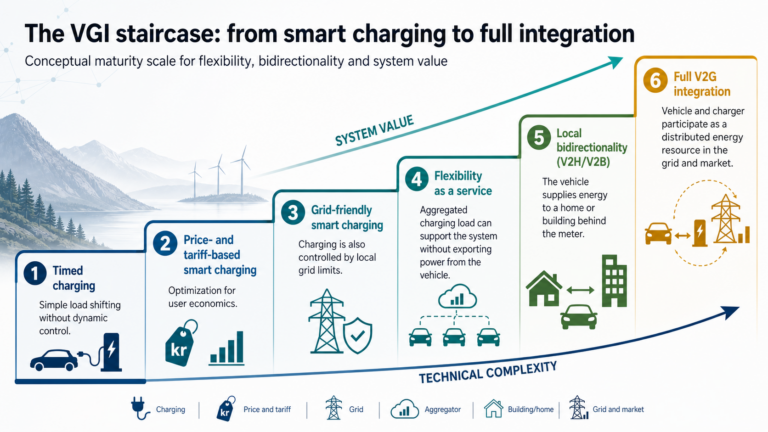
When the press, customers and most of us say V2G, we mean that the car sends power out to the grid. That’s also how the International Energy Agency (IEA) uses the term. The IEA distinguishes between smart charging (V1G), supplying a home or building (V2H and V2B), and V2G, where the car pushes energy from its battery into the grid.
The idea is almost thirty years old. In 1997, Willett Kempton and Steven Letendre described parked electric cars as a power source for electric utilities. The name came four years later. In June 2001, “vehicle-to-grid” appeared in the title of a report from Kempton’s group and AC Propulsion. That autumn, the state of California funded an AC Propulsion demonstration project with an electric Volkswagen Beetle. According to IEEE Spectrum, it was Tom Gage, then head of AC Propulsion, who came up with the name.
So that’s the narrow meaning: power out.
B: the system
But the people who coined the term meant more than that. In a 2005 article, Kempton and Jasna Tomić wrote that each car needs three things to take part: a connection for the power, a connection for communicating with the grid operator, and controls and metering in the car itself.
Communication was part of the idea from the start. V2G makes no sense unless the car and the grid talk to each other. The grid has to be able to say when it needs power, and the car has to be able to answer.
When the US smart grid effort took on the electric car around 2009, the working group was called “Vehicle to Grid”. It was to cover all interaction between the car, the charging system, the grid and the user, both charging and discharging. That’s the broad meaning: everything that happens between the car and the grid.
C: the protocol
Then came the standard that made the confusion complete. ISO 15118 is called “Road vehicles — Vehicle to grid communication interface”. Work began in 2009, led by Germany and France, and the first part was published in 2013. It defines V2G broadly, as the smart grid community did, and includes discharging.
The standard only covers communication between the car and the recharging station, though. The grid isn’t part of the conversation. Whatever happens behind the recharging station is left out of scope.
On top of that, “V2G” became a label inside the protocol. The messages between the car and the recharging station are called V2G messages, even when the car is charging in the ordinary way. A technician who says a car “speaks V2G” may only mean that it charges normally, with digital communication.
And power in both directions came much later. ISO 15118-2 from 2014, the first version of the message set itself, only covered power from the recharging station to the car. Bidirectional power was described as a goal for the next revision. It arrived with ISO 15118-20 in 2022.
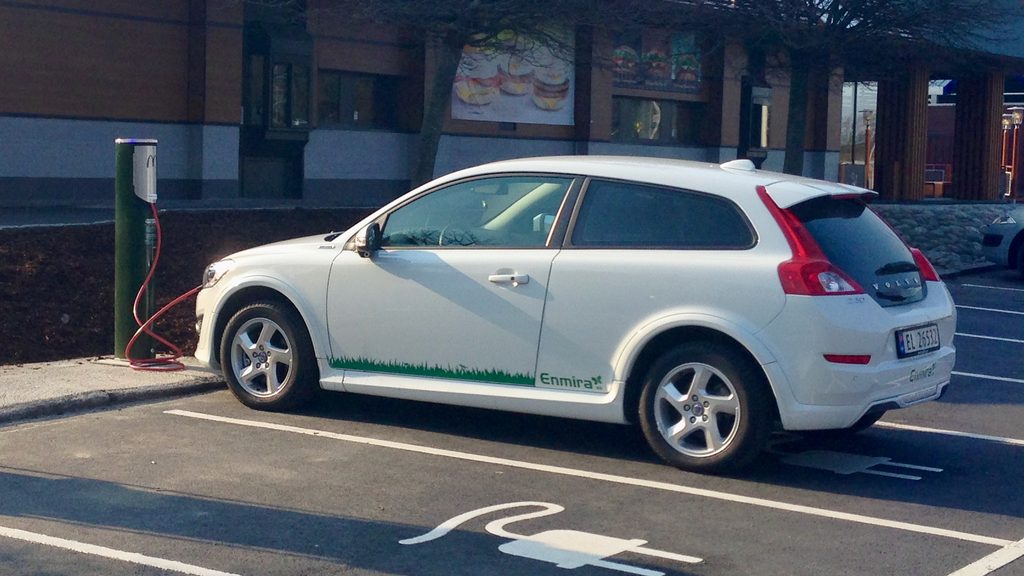
My own Volvo C30 Electric from 2013 is a good example. Its on-board charger could, in hardware terms, work in both directions, and the supplier said it only needed a bit more software. What was missing was a common language. That came nine years later.
When “grid” means recharging station
The people who translated the standard haven’t agreed on what “grid” means.
- German (DIN) and Swedish (SIS) have translated the title as “between the vehicle and the charging station”. That’s what the standard covers.
- French (ISO’s own French title) says “réseau électrique”, the electricity grid.
- Norwegian: Standard Norge has no Norwegian title. The standard is sold under its English one.
The EU can’t decide either. Commission Delegated Regulation (EU) 2025/656 sets the requirement for ISO 15118-20. In its annex, the heading of point 2.1 reads “communication between the electric vehicle and the recharging point (vehicle-to-grid communication)”. Recharging point and grid, in the same heading. It’s the same in every language version I’ve checked.
In the language of the standard, “grid” means the recharging station. In everyday language, it means the electricity grid. The legal text says both.
“Bidirectional” also means two things
One more thing adds to the confusion. The word “bidirectional” is used for two different things:
- Bidirectional communication. The car and the recharging station have exchanged data in both directions since the first version of ISO 15118. The EU uses the word this way too. AFIR defines a “digitally-connected recharging point” as one that can communicate bi-directionally with the grid and the car.
- Bidirectional power. Energy flows out of the car. The protocol has only covered this since ISO 15118-20 in 2022.
When a supplier says a recharging station “supports bidirectional”, ask: talking, or power?
No, the EU doesn’t require V2G from 2027
This is where it has practical consequences. The claim “the EU requires V2G chargers from 2027” keeps coming up. It’s wrong.
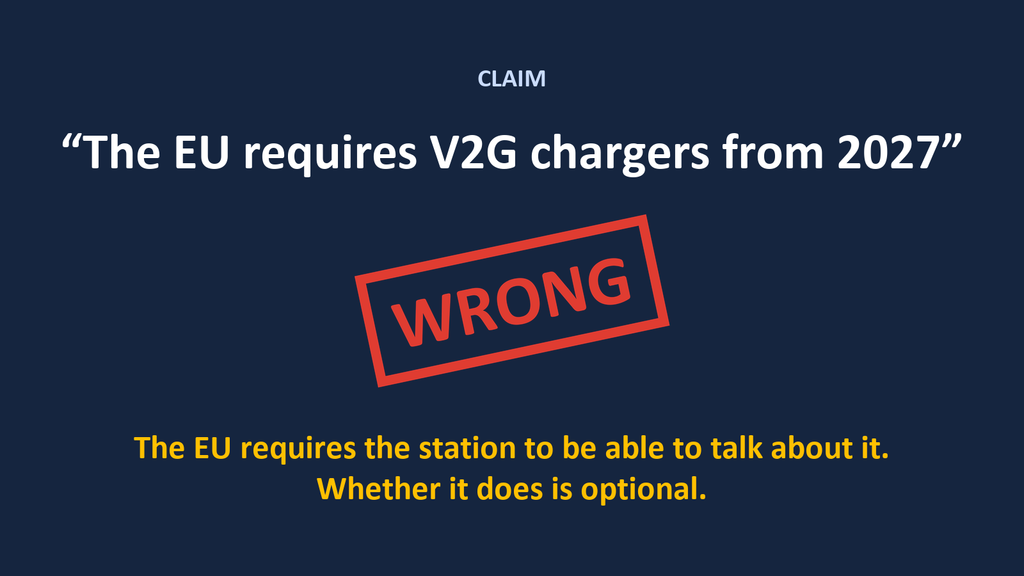
Regulation 2025/656 requires new and renovated recharging points in the EU, public and private, to support ISO 15118-20 from 1 January 2027. The requirement concerns communication. The recitals say plainly that operators decide for themselves whether to offer Plug & Charge, smart charging or bidirectional charging.
It’s easy to see why so many people believe otherwise. The EU itself justifies the requirement by pointing out that the older version lacks bidirectional charging, among other things. And when the legal text calls the interface “vehicle-to-grid communication”, it’s no surprise that the market hears “V2G requirement”. The confusion is built into the law.
Norway adds one more step. It isn’t an EU member, but it follows EU rules through the EEA Agreement. The Norwegian act on alternative fuels infrastructure has been passed but hasn’t entered into force. It’s waiting for AFIR to be incorporated into the EEA Agreement. Regulation 2025/656 hasn’t been incorporated yet either.
For installers, the requirement applies to new and renovated recharging points. Stations already on the wall aren’t affected. In the EU, it applies from January. In Norway, it’s on its way. If you’re choosing a recharging station for a customer today, pick one that already supports ISO 15118-20 or can be updated over the air. Nothing in the requirement says the station must be able to send power back. If someone promises the customer that it will, that’s a promise the EU hasn’t made.
Necessary, but not sufficient
ISO 15118-20 is the key. For cars with CCS, the Combined Charging System used across Europe, it’s the only standardised route to V2G. But there are more locks to open:
- Hardware. The car and the recharging station must be able to export power.
- Grid connection. Equipment that exports power has to meet grid requirements. The EU’s new network code for generators, RfG 2.0, is the first to mention V2G.
- Back end and aggregator. Someone has to control the cars and sell the flexibility.
- Metering and market. Without a price signal, there’s no reason to export.
The IEA wrote this year that interoperability between cars and recharging stations using ISO 15118-20 is very low, because carmakers have implemented it differently. Every commercial offer today is a package of one car model, one recharging station and one electricity tariff. In Norway, with more than a million electric cars on the road, there are still no commercial V2G offers.
If a customer asks
If you’re an installer, you’ll hear it from a customer: “My car is V2G-ready. Can you set it up?” Three questions help:
- Ready for what? V2L, V2H or V2G? Whether it becomes V2G or V2H is decided by whoever controls the recharging station.
- Talking, or power? Do the car and the recharging station only support the communication, or can they export power?
- AC or DC? Is the inverter in the car or in the recharging station? That decides who’s responsible, and whether it works on an IT grid. Much of Norway’s low-voltage grid is an IT system, with no neutral and 230 V between phases, which few other countries use. AC bidirectional charging is difficult on it, and DC solves the problem.
If you’re the customer, these are the questions to ask before you buy.
So what does V2G mean? It means the car delivers power to the grid, the car talks to the grid, and the car talks to the recharging station. All three are right. Only A makes the power flow backwards, and on the day that happens, it’s the installer who set it up.
Sources:
- Kempton, W. and Letendre, S. (1997): “Electric vehicles as a new power source for electric utilities”, Transportation Research Part D 2(3).
- Kempton, W. and Tomić, J. (2005): “Vehicle-to-grid power fundamentals: Calculating capacity and net revenue”, Journal of Power Sources.
- Eisler, M. N. (2023): “False Starts: The Story of Vehicle-to-Grid Power”, IEEE Spectrum.
- IEA (2026): Global EV Outlook 2026, chapter on V2G.
- ISO 15118-1:2013, ISO 15118-2:2014 and ISO 15118-20:2022, described in my own words.
- Commission Delegated Regulation (EU) 2025/656, annex point 2.1, and recitals 19 and 25.
- Regulation (EU) 2023/1804 (AFIR), Article 2.
- DIN Media, SIS and Standard Norge: catalogue entries for EN ISO 15118.