Standardise first, or you are only consolidating complexity
Over two days in July, the map of Nordic charging was redrawn. On 8 July, Finland’s Plugit acquired Helen’s charging business in Helsinki. The next day brought two more announcements: Statkraft and Eviny are merging Mer and Eviny Hurtiglading, and Vattenfall InCharge is buying Nima Energy’s Swedish fast-charging operation.
It is tempting to read this as drama in a young industry. I read it as something else. A market growing up. And a mature market makes very different demands on its infrastructure than one still in build-out.
The question is not whether consolidation is coming. It is coming. The question is whether what we have already built can actually be merged — and whether we can describe it precisely enough to know what we are merging.
Consolidation is market logic, not crisis
Network industries follow a familiar pattern. First the pioneer phase: many players, fast capital deployment, plenty of local variation. Then the maturing phase, where scale, uptime and the ability to spread fixed costs across greater volume decide who makes money. Telecoms went through it. So did the grid business.
The July numbers tell the same story. The combined Statkraft and Eviny company will have more than one million registered customers and operations in Norway, Sweden and Denmark, with Germany a likely next step. Eviny holds 57 per cent, Statkraft 43. The rationale the parties give is not more charging points. It is lower total cost and better profitability.
Vattenfall takes over 178 recharging points across 16 locations in Sweden, plus a pipeline of 254 planned points at 36 new sites. Plugit takes over 798 recharging points across 199 locations, serving more than 55,000 users.
None of this is primarily about building. It is about running what already stands there, more cheaply and more reliably.
A charging network is not dots on a map
Here is the part that rarely makes it into the press releases.
When two charging networks become one, the locations are not the hard part. Everything else is. Chargers from different suppliers. Communication protocols. Payment solutions. Data models. Customer databases. Operating systems, energy management and roaming agreements. Each of these layers either speaks the same language from day one, or has to be rebuilt.
This is where standardisation stops being abstract committee work and turns into a line in the business case.
If the chargers run on OCPP (the Open Charge Point Protocol, the open interface between a recharging point and the operating platform), you can change back-end without changing hardware. If they do not, you are locked to your supplier. If identification and payment follow established standards such as ISO 15118 and the common roaming protocols, customer bases can be merged fairly quickly. If they do not, you live with two apps and two price lists for years.
The difference between those two outcomes is not technical luck. It was decided when the procurement was written.
The deck of cards in my glovebox
I have owned an EV since 2011. For a few years I kept a small stack of RFID cards in the glovebox, one for each operator. That was not because the industry was incompetent. It was because every player built its own system in a market where the shared interfaces did not yet exist.
That deck disappeared because operators agreed to open their networks — and, just as importantly, did the work of developing a standardised way for the systems to talk to each other.
The lesson is not that standardisation is pleasant. The lesson is that the bill arrives either way. You either pay it up front, by building on common solutions. Or you pay it afterwards, through migration projects and technical debt.
199 of what, exactly?
Now for something that looks like pedantry and is not.
The press release announcing Plugit’s takeover of the Helen network describes “199 public charging stations and 798 charging points”. The Finnish original draws the line more clearly: julkista latausasemaa are the sites, latauspistettä are the outlets. In the English rendering, that distinction dissolves. “Station” becomes a word the reader intuitively pictures as something you drive up to and plug into.
AFIR and the EAFO framework settled this some time ago. A recharging point is a single interface that can charge one vehicle at a time. A recharging station is a physical installation at one location, made up of one or more recharging points. A recharging pool is one or more stations at a specific location.
The difference is not academic. 199 recharging pools is a very different thing from 199 recharging stations. One location can hold several stations, and each station several points. Blur the levels, and it becomes easy to oversell a network — and impossible to compare two.
When portfolios are priced, merged and reported across borders, the numbers have to mean the same thing on both sides of the table. Precise terminology is not an accessory to standardisation. It is standardisation, in linguistic form.
Europe has already taken a position
AFIR, the EU regulation on alternative fuels infrastructure, moves part of this from recommendation to requirement. Ad hoc payment without a subscription, price transparency and access to data are no longer left to the individual operator.
The vocabulary comes with it. Once reporting has to follow shared definitions, it gets harder to count locations and points interchangeably. That is an underrated benefit of the regulation.
And the framework is not quite finished with itself
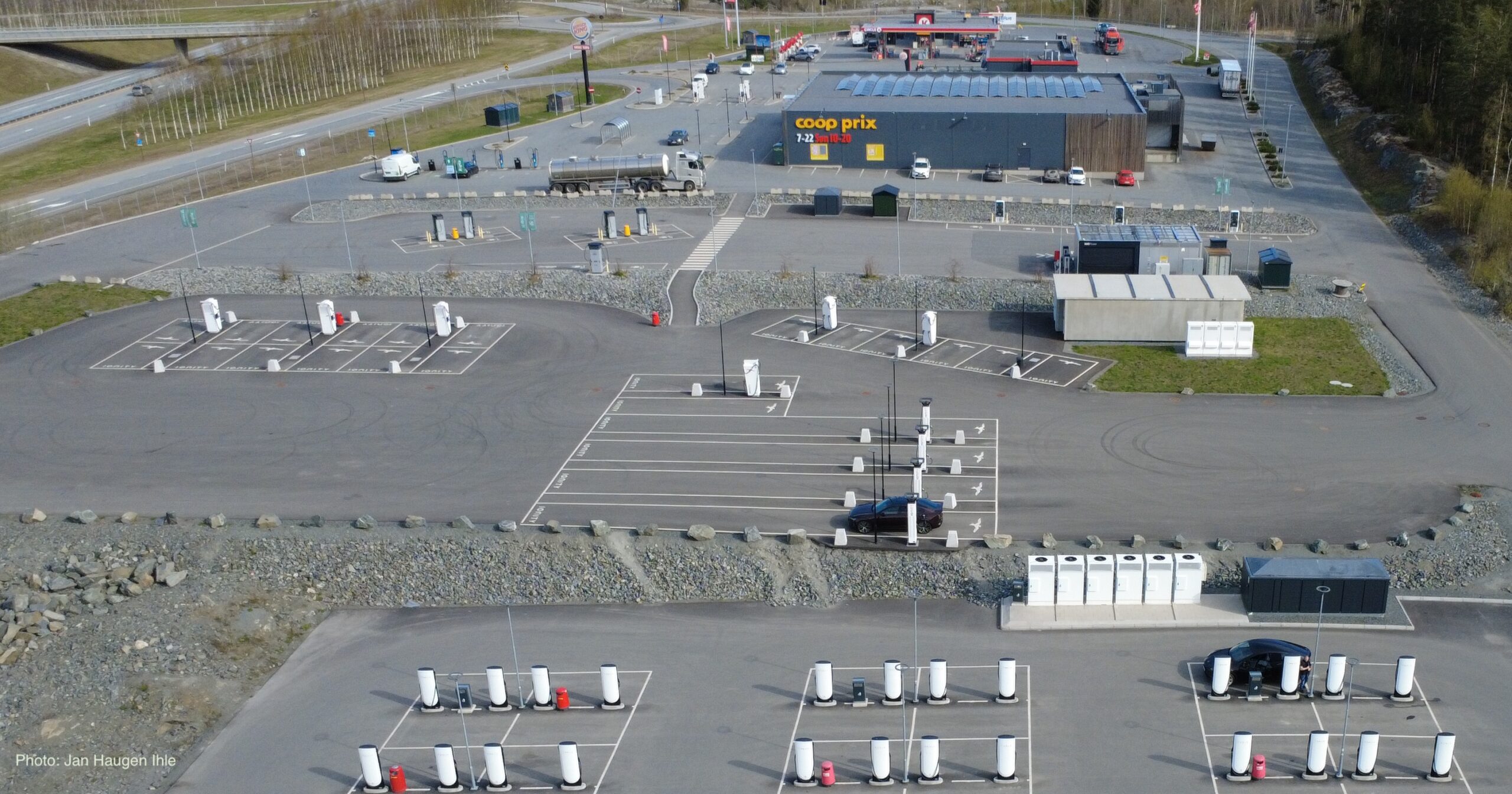
Take Innlandsporten on the E6 in Norway; see the picture at the top. Seven different charge point operators share a single site, with Ionity, Tesla and others each holding their own bays. How many recharging pools is that?
EAFO says seven. In EAFO’s definition, a recharging pool is operated by one CPO, at one address, with one set of coordinates. Seven operators, seven pools.
The Commission’s own questions and answers on AFIR say one. There it is stated that a recharging pool may consist of stations run by different operators, provided they sit at the same specific location. Motorway service areas and rest areas are given as the example.
Both answers are official. And each feeds different machinery. EAFO’s count underpins the statistics on European charging infrastructure. The AFIR reading underpins how Member States document compliance along the TEN-T network — where the requirements are written per pool, in total power output and number of points.
The same stretch of asphalt gives you seven or one, depending on which document you open.
This is not the industry being careless. It is a framework that has not finished settling. A term that returns two answers for the same site is not yet fully defined.
I would not call it a scandal. This is what happens when regulation and data models develop in parallel, in different rooms. It does need tidying, though, and that work belongs in standardisation. If consolidation, capacity targets and reporting are all to rest on the same figures, those figures have to mean the same thing the whole way through.
Norway as the early laboratory
Norway is further into the transition than most markets. According to OFV [CHECK: English rendering of Opplysningsrådet for Veitrafikken], zero-emission passenger cars held 97.63 per cent of the new-car market year to date at the end of June. Add a strong public role in build-out, high expectations on user experience, and active competition scrutiny of the fast-charging market. The Mer and Eviny merger remains subject to the necessary regulatory approvals.
That makes Norway a laboratory for what happens when charging infrastructure moves from build-out to mature operation. In that phase, adding points is not enough. The network has to be intelligible, operable and portable.
What a standardised network makes possible
The payoff becomes clearest when you look at what can be built on top.
Amp Assist is one example. The company delivers what it calls AI Operations as a Service: round-the-clock monitoring of charging networks, automated fault handling and driver support, sitting as an operational layer between the management platform and the customer. The service is hardware-agnostic and integrates with established operating systems, including through a partnership with platform provider AMPECO.
What matters for this article is the precondition. Amp Assist can offer the same service across markets precisely because OCPP and CCS are common. Without those standards, every customer relationship would have to be built as its own integration project, and the business model would collapse.
The same holds for language. A tool that reports uptime, fault rates and utilisation has to know whether it is counting points or locations. Muddled terminology produces muddled key figures.
For an operator that has just doubled its portfolio, this is concrete. A standardised network and clean terminology mean such an operational layer can be connected in a matter of weeks. Without them, it becomes a project.
Disclosure: I have found Amp Assist interesting enough that I am in dialogue with the company about a possible collaboration. You should know that when reading the section above.
What we are actually consolidating
The three July transactions are about more than changes of ownership. They show that charging is becoming a mature infrastructure sector. And in mature infrastructure sectors, the most inventive custom solutions rarely win. The standardised ones do, because they are what makes scale and interoperability possible at all.
Consolidation is not the problem. The absence of standardisation is the problem — in the systems, and in the language we use to describe them.
Ownership, systems and operations will consolidate. The question worth asking before your next procurement is a simple one: can this installation be operated by anyone other than the company that supplied it?