When “grid” means the garage
Norway’s Ministry of Transport has put the requirement for new recharging points to support ISO 15118-20 out to consultation. The ministry says the requirement will hardly apply to housing cooperatives and condominiums. It will. The whole misunderstanding hangs on one word.
A title that promises more than it delivers
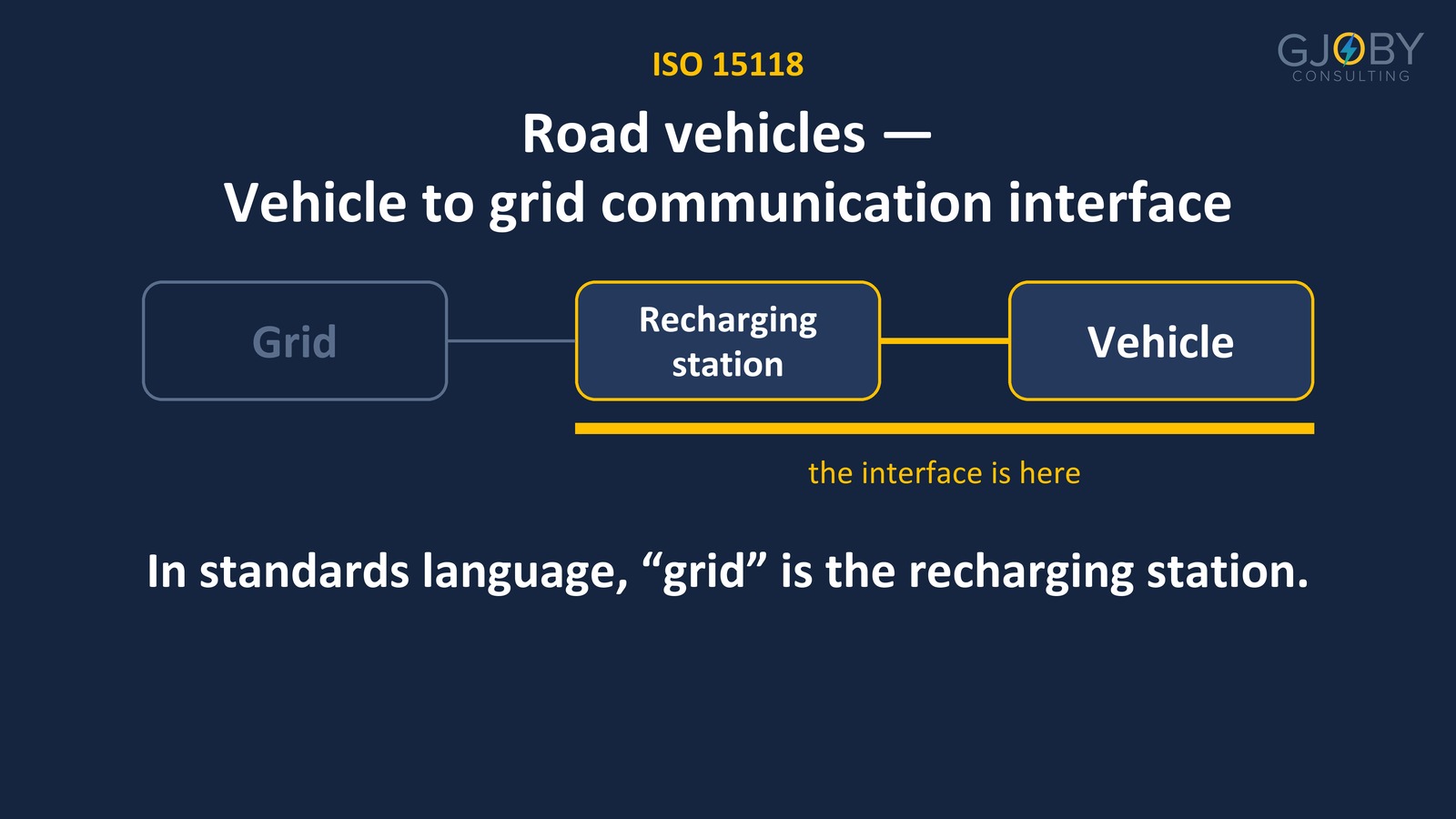
ISO 15118 is called Road vehicles — Vehicle to grid communication interface. Read the title at face value and the standard is about the car talking to the power grid.
It isn’t. It’s about the car talking to the recharging station, through the charging cable. The grid operator takes no part in the conversation. The protocol is used for ordinary charging, for smart charging and Plug & Charge, and from Part 20 also for bidirectional charging.
The IEC’s own vocabulary, IEC 60050, uses grid for the utility’s network. The electrical system in a house or a car park is an electrical installation. So the basement car park of a housing cooperative isn’t “grid” in any dictionary I know of, except in the title of this one standard.
I’ve written about this confusion before, in What does V2G mean?. Now it has found its way into a consultation on national regulations.
What the ministry wrote
Norway isn’t in the EU, but EU rules on alternative fuels infrastructure come to Norway through the EEA Agreement. On 29 October, the Ministry of Transport sent out a draft regulation that makes four EU regulations under AFIR, the Alternative Fuels Infrastructure Regulation, part of Norwegian law.
The consultation letter translates the title of ISO 15118-20 with the Norwegian word for the power grid. It then states that the specifications cover two-way communication between the vehicle and the grid. From that, the ministry draws a practical conclusion: in most cases the requirement will be of little relevance to shared installations in housing cooperatives and condominiums, and will only apply where power from the battery is fed back to the home.
A few days later, the same reading turned up in an industry newsletter: a standard is coming for new recharging points for bidirectional charging.
The reasoning holds together, once you’ve taken the title literally. That’s what makes the mistake so easy to make.
What the regulation says
The requirement is in the annex to Commission Delegated Regulation (EU) 2025/656, point 2.1.3. In the EU, private recharging points for mode 3 and mode 4, that is AC charging with communication and DC charging, must support ISO 15118-20 when they’re installed or renovated from 1 January 2027.
There’s no condition about bidirectional charging. And no distinction between a detached house and a housing cooperative.
The recitals spell it out. Recital 23 asks manufacturers and operators of both public and private recharging points to prepare their hardware and software for the standard. Recital 25 says bidirectional charging, smart charging and Plug & Charge are services the operator decides whether to offer.
So the requirement covers the language the recharging point speaks, regardless of what it’s used for. Exempting housing cooperatives because they won’t be doing bidirectional charging is a bit like saying seat belts are only required for people who plan to crash.
In fairness to the ministry, the draft regulation itself is correct. It makes the EU acts Norwegian law as they stand. The exemption for housing cooperatives appears only in the consultation letter, as the ministry’s interpretation. But an interpretation in a consultation letter tends to end up in the guidance, and the guidance is what installers read.
Why the shared car park is the worst place for an exemption
Shared car parks are where load management counts most.
When forty cars come home at the same time, they share one grid connection. Without communication, the recharging station can only limit how much power each car may draw. It doesn’t know how much energy the car needs, or when it’s leaving again. Load management shares out the capacity blind.
With ISO 15118-20, the car can tell the recharging station how much energy it needs and when it’s leaving. The system can then charge the car that leaves first and move the rest to hours with low load. That means lower peaks, lower grid tariffs for the housing cooperative and less need to upgrade the supply.
It’s simpler, too. Today, this kind of control often relies on separate cloud services from each carmaker or each manufacturer of recharging stations. With a common standard, the same information comes straight from the car, whatever the make.
Recharging points stay on the wall for 10 to 15 years. One installed without the protocol in 2027 may still be in use in 2040. By then bidirectional charging may be common, and smart charging almost certainly will be.
If the exemption stands, Norway will in practice have a national exception to a requirement that’s harmonised across the EEA. That’s hardly the intention. It’s certainly not what the regulation says.
For the record: none of these requirements apply in Norway yet. AFIR hasn’t been incorporated into the EEA Agreement, and the regulation can’t take effect until the national act comes into force. No date has been set. But it’s now that the understanding of the requirement is being formed.
What to take from this
In my view, the consultation should have been withdrawn, corrected and sent out again. When the consultation letter describes the requirement wrongly, respondents answer on the wrong basis. The deadline for responses in Norway is 10 December 2026.
I’ve sent a response myself. It explains why housing cooperatives and condominiums shouldn’t be exempted, and why the terms count. My worry is that many will respond on what bidirectional charging costs, and not on the requirement as written.
Norway won’t be the only country where this happens. Every EEA country has to apply 2025/656, and the title of the standard reads the same everywhere. If you’re working on implementation where you are, read point 2.1.3 for what it says. And use the terms of the regulation. AFIR defines recharging point, recharging station and recharging pool separately, and each requirement is tied to one of them.
In the title of the standard, “grid” means the power grid. In practice, it means the charging cable in the garage. The regulations should know the difference.
Sources:
- Norwegian Ministry of Transport (2026): consultation letter and consultation paper on four EU regulations supplementing the Alternative Fuels Infrastructure Act, ref. 26/4152, 29 October 2026. regjeringen.no/id3186497 (in Norwegian)
- Commission Delegated Regulation (EU) 2025/656, annex point 2.1.3 and recitals 23 and 25
- Regulation (EU) 2023/1804 (AFIR), consolidated version of 8 January 2026
- IEC 60050, International Electrotechnical Vocabulary (Electropedia)
- ISO 15118-20:2022, described in my own words